Friday
Room 7
15:00 - 16:00
(UTC+02)
Talk (60 min)
Lightning Talks 6
Lightning talks (approx 10-15 minutes each)
Talk 1: When AI writes the code, what do we do? - Tomas Hensrud Gulla
We live in a time where we can write code without understanding it. AI makes us faster, more productive, and less tired.
But what if programming isn’t just about efficiency?
What if it’s also about resistance?
Maybe the developer of the future doesn’t need to write more code. Maybe we need to play with it more.
I’ll show you examples of code written in some very different languages.
One language probably belongs on a wall. One you can’t even see. One should be performed at full volume. And the last one you absolutely cannot sit still while writing it.
This is part performance, part talk. Part humour, part serious.
Talk 2: How hunting for an attack surface, led me to the front-doors of wind turbines - Knut Erik Hollund
As a relatively new in the field of cybersecurity, with a primary focus on Application Security (AppSec), I have been intrigued by the methods attackers use to identify their attack surfaces. In preparation for an internal presentation at our company, I embarked on a project to explore potential attack surfaces using various tools. My objective was to identify a wind turbine farm located in Europe. This endeavor was aimed at illustrating the Secure Design principle - "defense in depth."
During my presentation, I will guide the audience through my journey, starting from the initial question to the point where I reached the front door of the wind turbine farm. It involves tools as AI and Shodan.io.
Talk 3: Breaking the Corporate Firewall: How to get a little AI into your very large company - Sean Percival
Your company is falling behind on AI. You know it. Your competitors know it. And somewhere deep in a conference room, a committee is meeting about it — which means nothing is going to happen for another eighteen months.
This talk is not about waiting for permission.
It's about how individuals — not executives, not transformation teams, not consultants — are the ones who actually change how large organizations work. One quiet experiment at a time. One small win that can't be ignored. One person who decided to stop waiting and start doing.
"In Norway, the fastest way to do something big is to start embarrassingly small."
The corporate firewall is real. Legal will say no. IT will say no. Procurement will say nothing for six weeks and then say no. But there is a way through — and it starts with you, a low-stakes test, and a result nobody can argue with.
Why large companies stall on AI — Death by committee. The approval loop. Why "we need a strategy" means nothing is happening.
Start embarrassingly small — One team. One tool. Four weeks. One metric. Why tiny experiments are the only things that actually get approved.
Isolate the blast radius — How to ring-fence risk so legal, IT, and compliance can say yes. The sandbox framing that unlocks everything.
Show results first, ask for permission later — Why data is the only currency that moves Norwegian organizations — and how to document obsessively so the numbers do the lobbying.
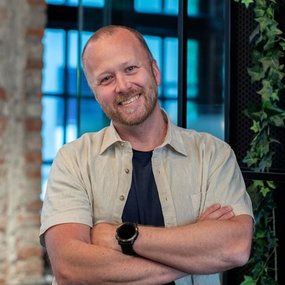
Tomas Hensrud Gulla
Tomas is a developer with more than 20 years of experience in the Microsoft .NET space. He enjoys learning new programming languages, regular expressions, skiing and beer.

Knut Erik Hollund
Knut Erik has been engaged with coding and computing since 1983, starting with the Spectrum ZX81 and Commodore VIC20. He holds a formal education in software development. His interest in cybersecurity emerged later in his career when he played a role in establishing the Application Security (AppSec) team. This experience left a lasting impact, fuelling his desire to further enhance his cybersecurity expertise.
Currently, Knut Erik is a leader at Bouvet, where he is responsible for building and managing a team of front-end and back-end developers. Additionally, he is spearheading an initiative to develop a team of AppSec and cybersecurity engineers. Knut Erik resides in Tananger, near Stavanger.

Sean Percival
Sean Percival is VP of Global E-commerce at Xplora, a large public company that doesn't entirely know what he's up to with regard to AI. Before Xplora, he was a partner at 500 Startups (early bets on Stripe, Canva, Dollar Shave Club), VP of Online Marketing at MySpace, and CMO at Whereby. He is the author of Working with Norwegians and has been building things on the internet since 1993.